
"We have been able to detect NASA's Lunar Reconnaissance Orbiter (LRO) and the Indian Space Research Organisation's Chandrayaan-1 spacecraft in lunar orbit with ground-based radar," said Marina Brozovic, a radar scientist at JPL and principal investigator for the test project.

'We hear about Chanda Mama from our childhood.' 'I am excited by the idea of seeing it with my eyes.'

This handout image from obtained from the European Space Agency / National Aeronautics and Space Administration, obtained on August 21, 2008 taken by the High Resolution Stereo Camera on board the ESA's Mars Express shows the highest-resolution full-disc image yet of the surface of the martian moon Phobos.
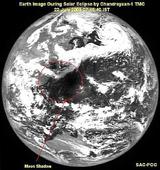
The images were captured by the Terrain-Mapping Camera (TMC) on board the 514-kg spacecraft, which is orbiting at 200 km above the lunar surface.

Deciphering its secrets will unlock the early history of not only our planet, but also of the star system, explains Kumar Abishek.

The joint mission envisages landing a new-generation lunar vehicle weighing 400 kilogrammes on the surface of the moon.
NASA said it is looking forward to explore the solar system with its Indian counterpart.
"In situ chemical analysis and resource exploration is the main objective of Chandrayaan-II," said Mylaswamy Annadurai, Project Director of Chandrayaan-I. Annadurai visited Russia late last month to hold initial technical discussions on Chandrayaan-II, which is expected to be a much shorter mission than Chandrayaan-I, scheduled for launch on April 9, 2008.
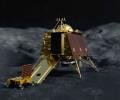
ISRO on Friday said it has made efforts to establish communication with its lunar mission Chandrayaan-3's lander Vikram and rover Pragyan to ascertain their 'wake-up condition' after they had been put into sleep mode early this month -- but no signals have been received from them as of now.
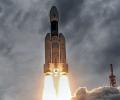
Chandrayaan-II hard-landed on lunar surface last year. The Indian Space Research Organisation had then resolved to launch the project again. It had said the project is likely to be launched by the end of the year.
"The duration of manoeuvre was 1,738 seconds. With this, Chandrayaan-2 was successfully inserted into a Lunar orbit," Indian Space Research Organisation said.
The spacecraft structure for the mission has arrived at the ISRO satellite centre from Hindustan Aeronauticals Limited and integration work has begun, S Krishnamurthy, director, Publications and Public Relations, told PTI from Bangalore.

For the second time in a year, a NASA camera aboard the Deep Space Climate Observatory satellite captured a 'lunar photobomb' -- a stunning view the Moon as it moved in front of the sunlit side of Earth, crossing over the Indian and Pacific oceans.
Efforts are also on for increasing the solar cell efficiency for energy production.

China's first lunar rover on Saturday successfully landed on the moon, making the communist giant one of three world powers to make a "soft landing" as part of an ambitious programme that aims to put a Chinese astronaut on the moon.

National Aeronautics and Space Administration's moon mineralogy mapper, an instrument on board India's lunar mission Chandrayaan-1, has clicked this magnificent image of the moon.The photograph shows a tricolour composite of reflected infrared radiation from the sun and illustrates the extent to which different materials are mapped across the side of the moon that faces the earth.Small amounts of water were detected on the surface of the moon at various locations.

Scientists will see two spacecraft slamming into the moon's south pole at 9,000 kmph kicking up a 10-km-high shower of debris that National Aeronautics and Space Administration (NASA) hopes will confirm the presence of enough water necessary to supply future visits by astronauts.

India, with its demonstrated capabilities of undertaking low cost high value inter-planetary travel, offers great opportunities for NASA to work with.

Director of Indian Space Research Organisation's Space Applications Centre based in Ahmedabad, Dr Ranganath R Navalgund said the terrain mapping camera, an Indian instrument on the lunar mission, has found "new types of rocks" and hollow tunnels.

The actor said his earlier tweet was referring to an old joke from the era of Neil Armstrong, the American astronaut and the first person to walk on the Moon in 1969.
In a belated action, defence public sector undertakings Bharat Electronics Limited has removed former Indian Space Research Organisation Chairman G Madhavan Nair from its Board of Directors as he was barred from holding any government post for his role in the controversial Antrix-Devas deal.

He said the ISRO scientists have a very strong spirit of working and will not rest till the objective is met.

In a huge setback to China's ambitious space programme, its first lunar rover Yutu or the Jade Rabbit was declared dead after attempts to revive it failed, media reports said on Wednesday.

Sukanya Verma lists her this week's OTT recommendations.

"I am extremely happy to announce that GSLV Mark III successfully injected Chandrayaan 2 in the defined orbit, infact the orbit is 6,000 km more than what was intended," Sivan said.

Chandrayaan-3 is now in an orbit, which when closest to Earth is at 173 km and farthest from Earth is at 41,762 km, the space agency said.

A US-led team has found that there is at least 100 times more water in the moon's minerals that was previously believed -- in fact, the scientists have based its findings on an analysis of the mineral apatite in lunar rocks picked up by Apollo space missions and in lunar meteorite found in Africa.
China's lunar mission aiming to send 'robotic explorers' before 2020, on Sunday landed its first satellite on Moon, as the Communist nation braces to compete in space technology with countries like the United States, Russia and India.

Recently, the government relaxed foreign direct investment (FDI) norms for the space sector by allowing 100 per cent FDI in manufacture of components, systems or sub-systems for satellites, ground segments, and user segments. It also permitted 74 per cent FDI in satellite manufacturing and operation as well as satellite data products and 49 per cent in development of launch vehicles and spaceports. Following this, stocks of related companies saw an uptick on the bourses.
Buoyed by the success of Chandrayaan-I, space scientists now plan to conquer new frontiers by sending a robot on moon in 2012 and a spacecraft to Mars the following year which will also see an Indian astronaut in space.
Harshal Parikh used to tell people that he was a member of ISRO's Moon mission and that senior officials of Defence Research and Development Organisation his friends.
Stanishev's engagements this week include a visit to the campus of Infosys Technologies Limited.
The American agency said the data from the two instruments Mineralogy Mapper and Miniature Synthetic Aperture Radar (Mini-SAR) will contribute to its understanding of the lunar environment and are part of its implementation of its space exploration policy which calls for robotic and human missions to the moon.
K Radhakrishnan, chairman of the Indian Space Research Organisation, has said that India is preparing to launch its second moon mission Chandrayaan-II by 2013. "The Chandrayaan-II we are planning to have in the year 2013. By that time, we should have our GSLV (Geosynchronous Satellite Launch Vehicle) flying with the Indigenous Cryogenic Engine Stage. That is the target with which we are working," said Radhakrishnan.
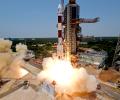
The successful launch of Aditya-L1 - the country's maiden mission to study the Sun - is expected to garner increased investor interest in the Indian space sector and trigger more funding for private players. Several private sector players, including Larsen & Toubro (L&T), MTAR Technologies, and Ananth Technologies, have played a pivotal role in the Indian Space Research Organisation's (Isro's) solar observatory mission. Aditya-L1 on Saturday set off on a 125-day journey on a PSLV-C57 rocket, in its attempt to study various elements relating to the nearest star from the halo orbit around Lagrange point 1 (L1) of the Sun-Earth system, which is about 1.5 million km from Earth.
The decision to provide Z grade security was taken by the Karnataka government following specific threats to ISRO scientists by the Lashkar-e-Tayiba and Dawaood Ibrahim.

The nominations for the 81st annual Golden Globes are out, and Barbie and Succession lead the list.
The Bharatiya Janaat Party's 'lotus' bloomed for the first time in south India in 2008 but the saffron party had little time to celebrate as Karnataka was rocked by serial bomb blasts in capital Bangalore and attacks on churches that drew flak in the country and abroad.
 © 2026 Rediff.com - Advertise with us - Disclaimer - Privacy Policy - Sitemap - Feedback - About us - Terms of use - Grievances